

 2026.5.30 - 7.4
Installation >>
Venue: nca | nichido contemporary art
Date: 5.30 (Sat.) – 7.4 (Sat.), 2026
Gallery hours: Tue. – Sat. 11:00 – 19:00 (Closed on Mon., Sun., and National Holidays)
Opening reception: 5.30 (Sat.) 17:00 ~19:00
Artists:
Olafur Eliasson, Jeff Gauntt, Ellen Kooi, Akane Morishita, Maria Nepomuceno, Kazuya Sakamoto, Keiso Yo
nca | nichido contemporary art is pleased to present the group exhibition Untamed Beauty.
Featuring the work of seven contemporary artists, Olafur Eliasson, Jeff Gauntt, Ellen Kooi, Akane Morishita, Maria Nepomuceno, Kazuya Sakamoto, Keiso Yo, the exhibition investigates the idea of beauty far from the conventional, traditional lesson. For some of these artists, it is the kind of beauty that lies hidden in plain sight, for others, it finds its expression in the form of a harmonious chaos of colors and shapes. Different representations, different approaches, yet, all these works bring to life a type of beauty that is untamed, whether because of the very nature of its object, whether because of the concept behind it, showing us that there is indeed beauty in simplicity.
Working in a wide range of media, including installation, painting, sculpture, photography, and film, Olafur Eliassons is renowned for his versatile, immersive practice blending art, science, and natural phenomena to explore perception and environmental awareness. The work on view presents an Icelandic landscape in two contrasting seasons. Only upon closer inspection does it become clear that the same scenery has been captured from an identical camera perspective once in summer and once in winter. The raw, untamed nature of Icelandic scenery inspired his fascination with natural elements such as light, water, and ice. This influence is evident in many of his installations, which often recreate or simulate natural phenomena within the controlled environments of galleries and museums.
The work by Jeff Gauntt featured in this exhibition comes actually from one of the artist’s earlier series, when his art, as Gauntt put it himself, “contained miniature landscapes” informed by the artist’s conflicted feelings about growing up in Houston’s suburbs. Small trees and landscapes conformed to the shape of the containers, with roots, tendrils, and branches breaking out, at times benignly cute, expressionless birds or fish painted instead of people to convey a sense of emptiness and post-human.
The work of Ellen Kooi brings to life scenographic, theatrical imagery that merges landscapes and figures in the tradition of the city's landscape painters from the Dutch Golden Age. One of the most prominent contemporary landscape photographers in Europe, Kooi urges us to seek the border between fantasy and reality. At first glance, the people that inhabit these panoramas of landscapes seem to be at the mercy of their surroundings. But if we look at these pictures more carefully we see a more complex relationship, as the landscape almost responses to its inhabitants. The displays of nature we see are a symbolic reflection of the inner feelings of these people. In a way comparable to nineteenth century psychological portraits, Kooi tries to tell us about myths, chance encounters and our relationship with the outside world heavily relying on the untamed beauty the landscapes offer.
The relocation to Oita prefecture, with its warm climate, lush greenery, and an abundance of natural resources, has marked a shift in Akane Morishita’s artistic practice: abandoning the use of traditional media, such as oil painting, which never felt natural or the right approach to her, Morishita started to work with natural elements collecting and processing raw earth into pigments, make stretchers and frames out of wood waste discarded by the local factories, and canvas out of sackcloth. Taking this process a step further, recently Morishita has been experimenting with fresco techniques, using stucco made by mixing together sackcloth’s fibers and slaked slime and applied with earth mixed with well water. Her work becomes a specific shot of the surrounding environment, of its texture and feel in that specific moment. Through her practice, Morishita is trying to reconnect with nature, bridging the frighteningly widening gap between our contemporary societies and the natural environment, all the while refraining from taming the raw power of nature. The exhibition features a selection of new and recent works.
Inspired by Brazil’s traditional craft techniques, Maria Nepomuceno has developed a unique process through which she creates organic sculptures and installations that incorporate methods of rope weaving, beads, unique ceramic forms and found objects. Evoking the joyful atmosphere of Rio’s Carnival with its bright, rich colors, Nepomuceno’s work embodies a variety of elements - Brazil’s culture and traditions, landscapes, animals – that range from the microscopic to the macrocosmic. The fluid, organic forms freely expand over the surrounding space, sometimes inviting tactile exploration. Nepomuceno has worked on several research-field projects that have put her in contact with different local communities. An example is the artist’s collaboration with the indigenous Huni Kuin people who inhabit the state of Acre in the north of Brazil and whose weaving techniques contributed to the evolution of Nepomuceno’s own style and process.
Plants have been the object of Sakamoto’s work ever since, growing waterweeds as one of his hobbies, he took notice of the similarities that such ecosystems seem to share with human society. Following the recent relocation of his artistic activity from Nagoya to Yonago, Sakamoto has picked up gardening, a change that, according to the artist, has paved the way toward his new interest in flowers and the survival strategies through which they continue their life cycle leaving seeds after blooming, in contrast with waterweeds that continue to rapidly grow through propagation. Through the cultivation, breeding and observation of flowers, Sakamoto has been using his work to explore the random and inevitable aspects of human life, its lifecycle, and the relation between humankind and nature. At times Sakamoto’s flowers seem to be the result of the artist’s impromptu, physical behavior; at others they seem to be intentionally embracing the randomness that comes with the painting process, elaborately built one layer after the other. Nevertheless, they represent the fleeting destiny, strategies and resilient nature of life, each manifesting its presence while coexisting in perfect harmony. The exhibition feature a selection of recent works by the artist.
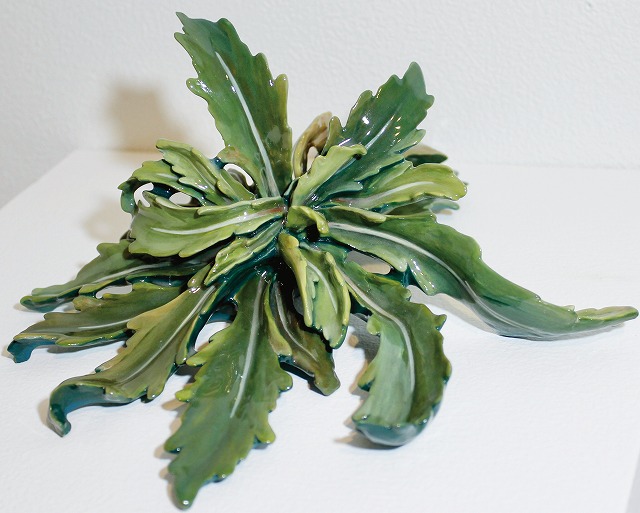
Growing freely and untamed through cracked asphalt and paving stones, patches of green grass seem to mirror life, its unpredictable and inextricable nature. Do they choose to grow surrounded by such a harsh environment, or is it the only place they can survive in? There is no way to know yet they keep on growing, on thriving. Through her ceramic work, Keiso Yo looks at the act of living as something delicate, where, at times, we are no longer in control. Yo draws a parallel between her previous ceramics, shaped like hearts and brains, dominated by a red hue, symbolizing blood, hence life, with her ceramic green weeds, where roots perform the same function as blood vessels; green replacing red, its complementary color. Yo’s work brings a sense of affinity and peace, pushing us to embrace the unpredictability and randomness of life. The exhibition features a selection of old and new works.