|
Landscape Reimagined2026.1.10 - 2.21Upcoming: 2026.1.10~ |
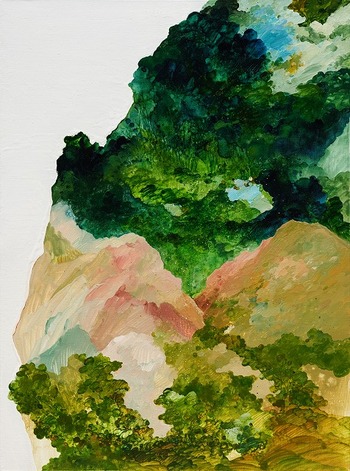
| ©Pin-Ling Huang |

Date: 1.10 (sat.) – 2.21 (sat.), 2026
Gallery hours: Tue. – Sat. 11:00 – 19:00 (Closed on Mon., Sun., and National Holidays)
Opening reception: 1.10 (Sat.) 17:00 ~19:00
Artists: Pin-Ling Huang / Shinya Imanishi / Lim Sokchanlina / Chihhung Liu / Vik Muniz / Janaina Tschape
Katsuzo Satomi / Sotaro Yasui *in collaboration with galerie nichido.
nca | nichido contemporary art is pleased to kick off the new year with the group show Landscape Reimagined. The exhibition brings together a selection of works by contemporary and modern artists, respectively represented by nca and galerie nichido, who, throughout their career, have explored landscape art. In particular, by taking a look back at the modern tradition and how it paved the way for the generations that followed, the exhibition wants to investigate how widely and uniquely this genre has evolved presenting seven contemporary artists, represented by the gallery, who, through their work, have reimagined landscape art from a contemporary perspective. Abstract, emotional representations of the artist’s inner world; recordings of bits and scraps from everyday life; exposure of issues faced by today’s societies, retracing of past lessons that challenge the viewer’s sense of perspective. Each through their unique expressive language, the artists on view has successfully embraced the landscape element in their artistic practice to address deeper, at times more pressing, issues, seeing beyond its physical limitations. Landscapes to tell stories about life, history, society, retracing the past, living the present, envisioning the future.
Pin-Ling Huang’s landscapes breathe life into new worlds that take shape directly from the many sketches and studies the artist records in her sketchbook. Creating a spatial structure that floats under the fluid brushstrokes and layers of thick paint, Huang’s imagery continues to unfold new visual possibilities following the viewer’s stance and perspective while walking the line between representation and abstraction. Backbone of her expressive language is the artist’s everyday life which she blends with her personal experiences and the memories she made during her journeys, bringing to life new scenery that, while imaginary, seem to evoke emotions of nostalgia in the viewer.
While drawing on Eastern philosophy, Western pictorial traditions, and Japanese art, Imanishi investigates the relation between material and image, perspective and distance, trying to give visibility to the ambiguity and uncertainty of those things we deem familiar. The smallest change in our perspective or stance brings to light new visual possibilities showing us how our own existence and reality are bursting with changes, ever-so organic and unpredictable.
Through his diverse artistic practice, Lim explores the changes happening in today’s Cambodia, whether from a political, economic, environmental, or cultural perspective, taking a look at the issues this entails. Lim has been documenting how landscape and society have been drastically changing due to the massive globalization of capital flows and the many hidden political agendas at play, using his work to warn us of a future where local realities with their communities, culture and nature may slowly fade away.
Drawing inspiration from a variety of sources - literary fiction, poetry, and philosophy to name a few - Liu has developed a unique, expressive language where the scenery and events the artist experiences during his journeys intertwine with the randomness of everyday life. It is the artist’s attempt, through his exchanges with local communities and his extensive experience in field research, to frame, on different levels, aspects that could hardly be put into words - sounds, time, emotions – and give them visibility moving beyond the sole representation of the natural landscape or the observation of the world.
Among Vik Muniz’s extensive production many are the works dealing with themes such as society, nature and the earth, starting from his series Pictures of Earth. Whether images of famous works originally painted by the hands of well-known artists, actual sceneries or, yet, comical bits, Muniz cleverly reconstructs the original images through the use of a variety of materials – garbage, thread, puzzle pieces, scraps of paper, sugar grains, and chocolate, for instance -, always presenting them in the end as photos. By employing common, familiar materials and images, Muniz is redefining our perception of reality while breathing life into new perspectives. Moving back and forth between the past and the present, embracing a rapidly evolving world, Muniz gives us a wary look, while though through his impeccably amusing practice, as to what the future might have in store for us.
Janaina Tschäpe walks the line between fantasy and reality through an artistic practice that ranges from painting, photography, video, to sculpture. Tschäpe’s abstract paintings explore nature in all its manifestations – elements of aquatic, plant and human life -; their organic, intimate, dynamic shapes call to mind the evolution of life and its metamorphosis, and appear as something naturally formed.
Tschäpe’s work greatly reflects the lush, natural environment that surrounds her studio in Brazil, and through her own personal relation with nature the artist navigates the complex interaction between humans and the natural world.
Following his time in France where he studied art, Sotaro Yasui (1888 – 1955), one of Japan’s Western style painting’s masters, became strongly inspired by French painters, especially by Paul Cézanne. Yasui’s landscapes, capturing Japan’s sceneries with a unique touch, while embracing Cezanne’s dynamic, multilayered pictorial style, were highly praised for their bold lines and delicate hues, and still represent a source of inspiration for many contemporary painters. Katsuzo Satomi (1895 – 1981), another painter from the same generation, was deeply drawn to Yasui’s practice. Satomi traveled to France where he studied under Vlaminck. He created a unique expressive style that conveys feelings, as well as the temperature of that time, accompanied by strong and vibrant colors deeply inspired by Fauvism.

